


About This Lesson
Lesson Plan: Art as Resistance/Graffiti on the Apartheid Wall/Separation Barrier
- CCSS.ELA-LITERACY.RI.7.1, 8.1, 9-10.1 (Evidence): Cite specific textual and visual evidence to support analysis of what the art says explicitly about social or political issues.
- CCSS.ELA-LITERACY Informative/Explanatory Writing (W.9-10.2): Produce informative/explanatory texts to examine complex ideas, utilizing relevant facts, definitions, details, and quotes.
Objective(s): In cooperative groups, students will cite visual evidence to support political analysis of Palestinian graffiti on Israel’s “apartheid wall” or “separation barrier.” Students then read and respond to an essay about art as resistance.
Essential Questions: What evidence can you find in the murals of themes such as: injustice;; youth in rebellion; community vs. division; freedom vs. oppression?
Culminating Assignment
Read the article and write a summary-response essay. First, summarize (1/3rd of the paper) the author’s main argument and supporting points. Then write a response (2/3rd) in which you analyze, evaluate or reflect on the text, stating whether you agree, disagree or both.
Extension Activity: Research Banksy, his art (gorilla graffiti), locations (Ireland, England, Palestine) and purpose (messaging).
Anticipatory Set/Hook: Journal Prompt:
The teacher chooses one of the words/phrases below as a journal prompt.
When I say ____________, I want you to write the first thoughts that come to your mind and write until I say “Stop.”
Examples: graffiti; the wall; resistance
Students write their responses, then share in pairs or with the whole class.
Steps in the Process
- Hook/Journal Prompt
- Refer back to the standard in addressing the lesson’s objectives.
- Show Jonathan Green’s “Conflict in Israel/Palestine through 2015”- Crash Course
- Review contrasting maps of Palestine/Israel.
- Introduce: Context: About the Wall/Barrier
- Count off groups of 1’s, 2’s, 3’s, 4’s and conduct a gallery walk, explaining that the photos were taken of what Palestinians call Israel’s “apartheid wall” and what Israel describes as the “separation barrier” between Israel and its occupied territories.
- Ask each group to answer the questions: What do you see? What is the message?
- Students share what they saw in the photos and what they found most interesting.
- Explain the class will read the article, “From Piece-Making to Peacemaking: The Influence of West Bank Graffiti Art” published by Harvard.EDU. Cut up the article into paragraphs or sections and distribute one section to each group. Have the group read their section and provide a summary and response.
- Invite one person from each group to come up to the front of the class and in succession explain their section and response.(alternatively read the article as a whole class, instructing the students to annotate each section).
Class Discussion Questions
- Why does the author Dara Adamolekun say that graffiti can be a revolutionary art form? (pages 2 & 3)
- What is the “apartheid wall” or “separation barrier”? (page 4 “The Canvas”) What did the International Court of Justice conclude? (page 5)
- What are common symbols on the wall? (page 7)
- Who is Banksy? Why did he visit the West Bank? Why have some criticized him? What has been his response?
- What does the author think of the art on the wall? Why does she argue it is important?
—--------------------
Background on the Murals
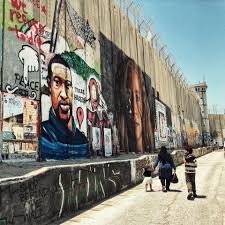
GEORGE FLOYD & AHED TAMIMI mural on the wall near Bethlehem; created by the Palestinian artist Taqi Spateen , who used the wall as a canvas to protest police brutality and draw parallels between Floyd's killing and Palestinian experiences with state violence.
The woman with the large face in the George Floyd mural on the wall is Ahed Tamimi, a prominent Palestinian youth activist, painted by artist Taqi Spateen alongside Floyd to highlight global struggles against injustice and police brutality, symbolizing shared causes of resistance. Best known for appearances in photos and videos in which she confronts Israeli soldiers, she has been hailed by pro-Palestinian activists as a symbol of Palestinian resistance against the Israeli occupation. (Wikipedia)
MAKE HUMMUS NOT WALLS created by Issa" (Palestinian Artist).
The phrase "Make Hummus Not Walls" is a popular slogan and theme in Palestinian resistance art; Hummus, a staple of Middle Eastern cuisine, represents shared culture and community, making "Make Hummus Not Walls" a call to build bridges, share, and connect people rather than divide them. Issa painted “Welcome to the shopping mall” over the “Make Hummus Not Walls” message after British street artist Banksy opened “The Walled off Hotel.” Banksy encouraged visitors to buy spray paint at the nearby “Wall Mart” to paint slogans, murals and their names over the mural. Issa protested “occupation tourism” in Bethlehem, where critics charge tourists are “exoticising Palestinian trauma.”
BLINDFOLDED MAN & ISRAELI SOLDIERS:
A mural of a blindfolded Palestinian being arrested by two Israeli soldiers carries the message: "We can't live, so we are waiting for death." To the right, a mural of a young man with a slingshot aimed at the burned out tower and the message: 'One day the sun will shine on a free Palestine.' (out of frame). (Apartheid Art: The Stories Behind Striking Palestinian Graffiti. Bahira Amin. Cairoscene.com. 10/23/23)
ARMORED DOVE
The famous "Armoured Dove" or "Dove of Peace" on the Israeli West Bank barrier (often called the apartheid wall) was painted by the anonymous street artist Banksy during a visit in 2005, depicting a peace dove in a bulletproof vest with a target, symbolizing the fragile and threatened nature of peace.
Key Links
YouTube Video: Conflict in Israel/Palestine through 2015/Crash Course/John Green
https://www.youtube.com/watch?v=1wo2TLlMhiw&t=10s
Articles
From Piece-Making to Peacemaking: The Influence of West Bank Graffiti Art (Dara Adamolekum. Harvard.Edu. 8/19/22)
Palestinians hit back at graffiti tourists (Jaclyn Ashley. Al Jazeera, 12/27/17)
https://www.aljazeera.com/features/2017/12/27/palestinians-hit-back-at-graffiti-tourists
The Separation Barrier (B’Tselem. The Israeli Information for Human Rights in the Occupied Territories) 11/11/17)
A key factor in determining the barrier’s route was the location of settlements, thereby laying the groundwork for the de facto annexation of most of the settlements and much land for their future expansion.
https://www.btselem.org/separation_barrier
“Saving Lives-Israel's Security Fence” (Israel Ministry of Foreign Affairs. 11/26/03)
“As a result of the unceasing terror, Israel decided to erect a physical barrier.”
https://www.gov.il/en/pages/saving-lives-israel-s-security-fence
Stop the Wall
https://stopthewall.org/the-wall/
Compare Maps
Map of the Middle East (GIS Geography)
https://gisgeography.com/middle-east-map/
Palestine: World Atlas
https://www.worldatlas.com/maps/palestine
Israel (Britannica Encyclopedia)
https://www.britannica.com/place/Israel
Israel Regions Map (Judea & Samaria)
https://israelmap360.com/israel-region-map
Israel and the Occupied Territories (Wikimedia Commons)
https://en.wikipedia.org/wiki/Israeli-occupied_territories
Photos of the Murals
George Floyd & Ahed Tamimi
Make Hummus Not Walls
Man in Blindfold (The Daily Bruin)
Context/History of The Wall
Israel began building its controversial West Bank separation barrier/apartheid wall in 2002 with the stated goal of preventing violent Palestinian attacks, though most of the wall runs deep inside Palestinian territory (not just along the ‘67 border), resulting in severe economic and social impacts on Palestinians (farm access, hospital access, isolating communities). In 2004, the International Court of Justice, the highest judicial body of the UN, declared the 440-mile long wall illegal because it violated Israel's obligations under humanitarian law and human rights conventions. The ICJ required Israel to dismantle the wall and compensate its Palestinians, but Israel has, instead, built new sections of the wall, further isolating Palestinian villages. (UN; BT’Selem)
##