

. Skip to main content
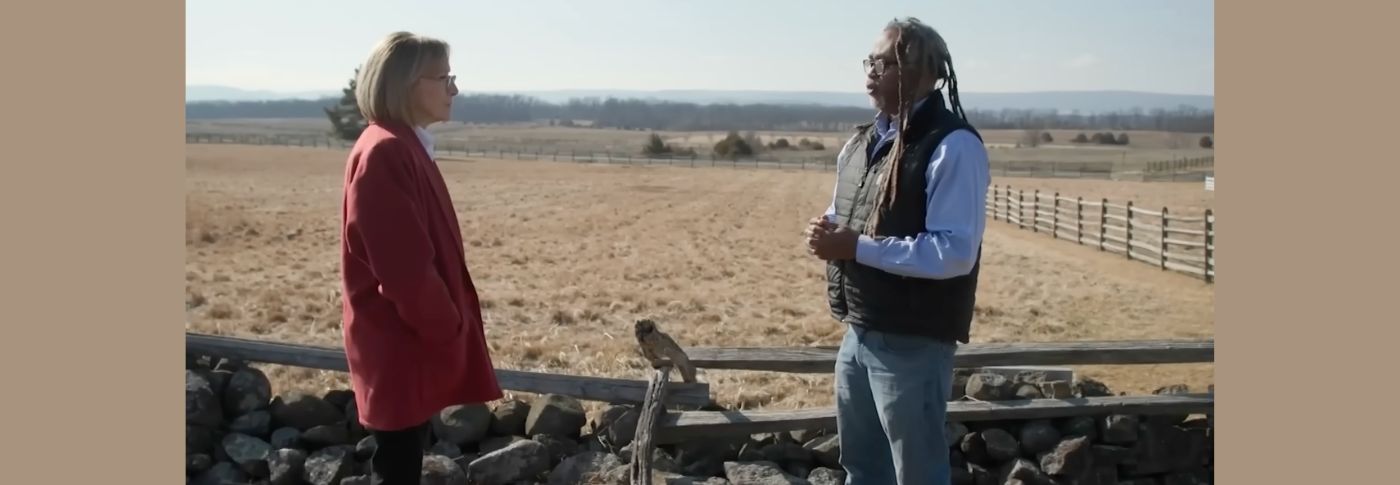
Judy Woodruff and Alan Spears of the National Parks Conservation Association speak outdoors near a historic landscape while discussing Americans’ differing views on the nation’s history ahead of the 250th anniversary.

Judy Woodruff speaks with Alan Spears of the National Parks Conservation Association about differing views on U.S. history as the nation approaches its 250th anniversary. Credit: PBS NewsHour.

Americans Divided on Nation's History as 250th Anniversary Nears

March 25, 2026

Americans Divided on Nation's History as 250th Anniversary Nears

As the U.S. approaches its 250th anniversary, Americans remain divided on how to understand and teach the nation’s history. What’s behind these differing perspectives?
Share

Share On Facebook
Share On Twitter
Share On Pinterest
Share On LinkedIn
Email

NOTE: If you are short on time, watch the video and complete this See, Think, Wonder activity: What did you notice? What did the story make you think about? What would you want to learn more about?

Deep divisions over how Americans remember their past are coming into sharper focus as the nation approaches the 250th anniversary of the Declaration of Independence. Judy Woodruff reports for her series, America at a Crossroads.

View the transcript of the story.

Remote video URL

Warm-Up Questions

  1. Where does Alan Spears work?
  2. What historic discovery did Spears make, and why did he think it was important?
  3. Why is Spears concerned about the Trump administration's changes to historical markers?
  4. What does President Trump's executive order on historical memory say should be highlighted at historical sites?
  5. How does Brenda Hafera defend the Trump administration's changes to historic markers?

Essential Questions

Who do you think should decide how public history such as monuments or museum exhibits are displayed?

Media literacy: How do you think Judy Woodruff chose the two main interview subjects in this segment? What perspectives do they represent? Do you think they represent a balance of perspectives or not, and why so?

What Students Can Do

Watch the following segment on preservation of historical material in the face of changes to the Smithsonian museums. As a class, brainstorm — what aspects of the history of the U.S. do you think it's important to highlight? How can everyday citizens help preserve that history, regardless of actions of the federal government?

Remote video URL

As a class, discuss public art and history in your own community.

  • What monuments, museums or other public art tell the story of where you're from and some of the people who helped build your community?
  • If you could choose one person, place or event to memorialize as a monument, exhibit or through public art, what would you choose?
  • If there's time, sketch out your idea and share as a class!

News: Then & Now

The News: Then & Now section of the Daily News Lessons allows students to see connections between current and past news events. The activity provides historical context using primary sources from the Library of Congress.

See PBS News Hour Classroom's Journalism in Action website for interactive examples of how journalists covered key events in U.S. history while honing your primary source, civics and digital news literacy skills.

Then

Two hundred years ago, Americans viewed the Centennial (100 years after independence) in a variety of ways similar to how Americans view the Sesquicentennial (250 years after independence) today. Read the two excerpts in James Dabney McCabe's 1875 book, "The Centennial History of the United States":

From the preface:

NEWS: THEN & NOW The News: Then & Now section of the Daily News Lessons allows students to see connections between current and past news events. The activity provides historical context using primary sources from the Library of Congress.  See PBS News Hour Classroom's Journalism in Action website for interactive examples of how journalists covered key events in U.S. history while honing your primary source, civics and digital news literacy skills.  THEN Two hundred years ago, Americans viewed the Centennial (100 years after independence) in a variety of ways similar to how Americans view the Sesquicentennial (250 years after independence) today. Read the two excerpts in James Dabney McCabe's 1875 book, "The Centennial History of the United States":  From the preface:
NEWS: THEN & NOWThe News: Then & Now section of the Daily News Lessons allows students to see connections between current and past news events. The activity provides historical context using primary sources from the Library of Congress.See PBS News Hour Classroom's Journalism in Action website for interactive examples of how journalists covered key events in U.S. history while honing your primary source, civics and digital news literacy skills.THENTwo hundred years ago, Americans viewed the Centennial (100 years after independence) in a variety of ways similar to how Americans view the Sesquicentennial (250 years after independence) today. Read the two excerpts in James Dabney McCabe's 1875 book, "The Centennial History of the United States":From the preface:

McCabe also writes in his preface: "An honest effort has been made to do justice to both sections in the relation of the events of the civil war, and it is believed that each will admit the fairness and accuracy of the narrative. The author has made no attempt to intrude his own political views upon the reader, and has constantly kept in mind the purpose which has guided his labors—to write a national history free from sectional or partisan bias, which shall be acceptable to the whole country."

Chapter 7: Progress of the Virginia Colony focuses on enslaved people arriving from Africa to Virginia in 1619 to be sold into bondage (NOTE: the term "Negro" is used, which is seen as socially unacceptable and outdated):

Mccabe, James Dabney. The centennial history of the United States. [Philadelphia, Pa., Chicago, Ill. etc. The National publishing company, 1875] Pdf. https://www.loc.gov/item/02002728/.

Now

In addition to holding events celebrating America 250, organizations, schools, communities are also examining how America could better meet the ideals of liberty and equality laid out by those men and women who fought for independence 250 years ago.

  • The essays on In Pursuit, an initiative by More Perfect, examine how we can learn from the past to inspire and inform America's future. The essays point to great accomplishments and well as serious faults of well-known figures in American history, including Thomas Jefferson, written by Andrew Davenport, and George Washington, written by former President George W. Bush. In Pursuit will publish two news essays a week now through December 2026. Check out the series here.
  • In its "250 & Beyond initiative," The National Museum and Center for Service encourages Americans to volunteer and take part in service opportunities in order to build stronger communities across the country: "If our nation is to last another 250 years, we must renew and sustain the American spirit of service among all our people and institutions."
  • Oregon Humanities has created several programs as part of their "Beyond 250" initiative to "hold conversations, create spaces for reflection and mutual understanding, and think together about the next 250 years."

These are just a few examples of how Americans are reflecting on the past and looking towards the future of our nation. Research more examples online. How is your community observing America 250?

Discussion Questions

  1. Do you sense a bias in McCabe's writing? Explain. Is it possible for an author/journalist not to include their bias or personal feelings in a story? Do you find that challenging in your own writing?
  2. In McCabe's Chapter 7: Progress of the Virginia Colony, what did you notice? What did you think about it?
  3. How is the way in which the America at a Crossroad's piece discusses how Americans see their past similar or different to the way in which James Dabney McCabe writes about America's past?
  4. Do you think it is possible to both celebrate America's rich history but be critical of its past? Explain.

America at 250: From Revolution to Republic

This collection traces the nation’s journey from colonial life and growing resistance to British rule, through the Revolutionary War, the Declaration of Independence, and the creation of a new constitutional government. Organized thematically, the resources support instruction in U.S. history, civics, and ELA while encouraging inquiry, discussion, and critical thinking.

Republished with permission from PBS News Hour Classroom.

PBS News Hour Classroom
PBS News Hour Classroom helps teachers and students identify the who, what, where and why-it-matters of the major national and international news stories. The site combines the best of News Hour's reliable, trustworthy news program with lesson plans developed specifically for... See More
Advertisement

Post a comment

Log in or sign up to post a comment.