Rocking My Daughter to Sleep During Women’s History Month
A mother reflects on rocking her daughter to sleep during Women’s History Month and why it matters that girls see themselves in the stories we teach. This blog explores the origins of Women’s History Month and highlights classroom resources—from short history videos to inclusive lesson collections—that help educators center women’s contributions and teach a fuller, more accurate version of history.
Women’s History Month shouldn’t have to exist. But unfortunately, it needs to. In a perfect world, women’s contributions would be so fully woven into our history books, classrooms, leadership structures and collective memory that dedicating a single month to them would feel unnecessary. But for far too long, women were left out of the narrative. Their discoveries were minimized. Their leadership was overlooked. Their voices were silenced or softened.
There is a common misconception that the word “history” derives from “his story,” but this is not the case. In fact, the word comes from ancient Greek. It traces back to the Greek word “historia,” meaning “inquiry” or “learning by investigation,” and originally referred to gaining knowledge by asking questions (Lovejoy, 2025). However, it is no surprise that this misconception arose; for centuries, the history many of us have learned is“his story”—and in the United States, particularly the stories of white men.
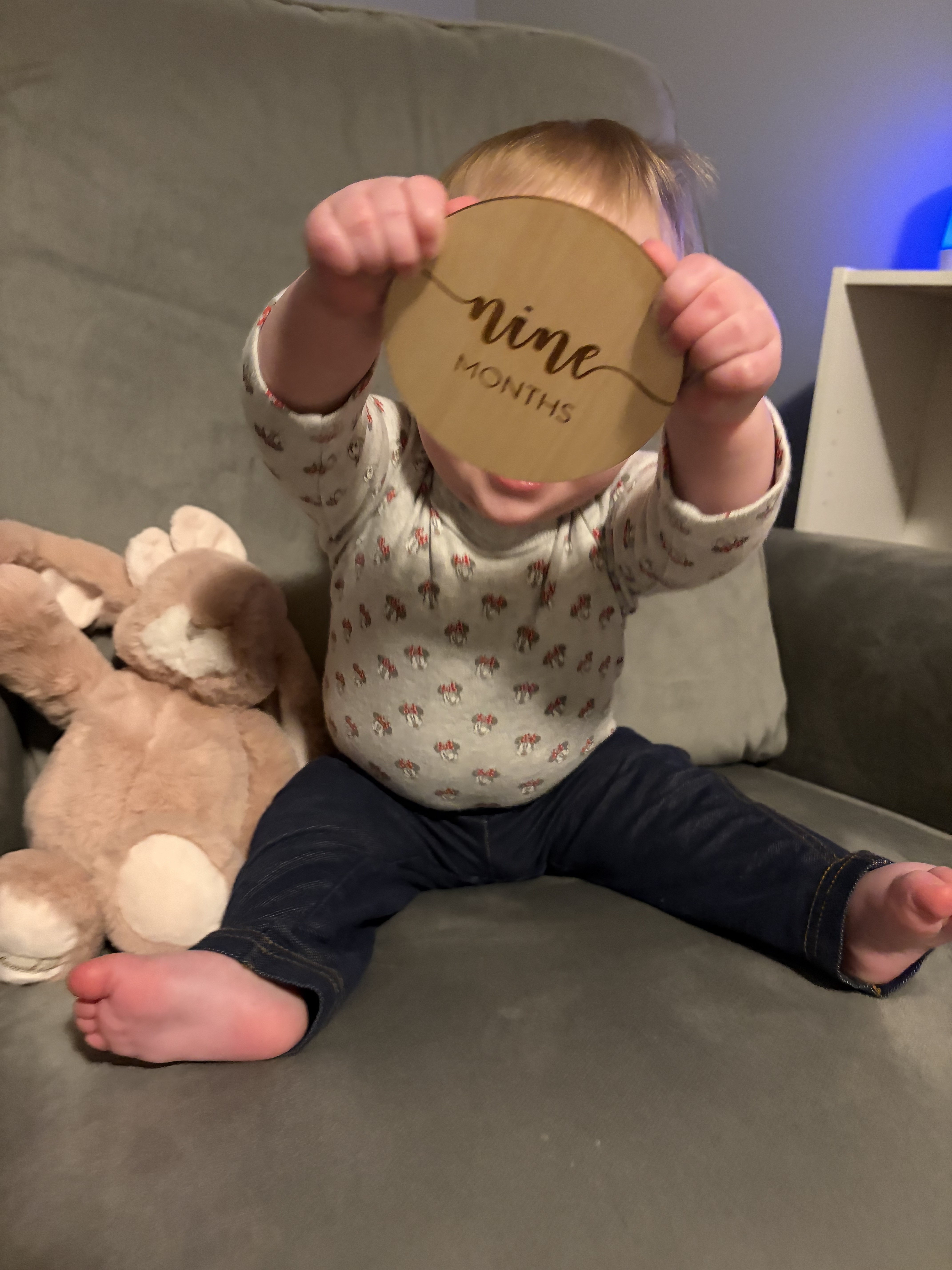
The author's daughter holding up her 9 month sign.
As I sit and rock my 9-month-old daughter to sleep at night, I have been thinking about this quite often—how history has so commonly reflected his story. I look at her peaceful face as she drifts off to sleep, and in these quiet moments, I reflect on what I want in life for her. I want a life for her in which she sees herself in books and lectures and discussions of history. I never want her to question what she is capable of—to wonder whether she, as a woman, can be a leader, inventor, innovator, creator or change-maker. I want her to recognize that women have long not only been helpers but also pivotal players in the development of this world, and she too can have a place in the pages of history. But when history focuses so heavily on the story of men—and presents that version as complete—it becomes easy for girls and women to subconsciously absorb the message that importance looks like someone else.
The Origins of Women’s History Month
Incredible individuals have long been working to dismantle this subconscious message. Women’s History Month exists because in 1978 five women who made up the Education Task Force of the Sonoma County Commission on the Status of Women recognized that it was an incomplete history that was being taught in schools. The task force, led by 24-year-old history teacher Molly Murphy MacGregor, organized a weeklong celebration in Santa Rosa, Calif., to coincide with International Women’s Day. Its goal was to ensure that women’s historical contributions were recognized and taught in schools. The idea gained traction nationwide, and in 1980 President Jimmy Carter issued a proclamation declaring the week of March 8 as National Women’s History Week. By 1987, Congress expanded the observance to the entire month of March—officially establishing Women’s History Month (National Women’s History Museum, n.d.).
Remote video URL
The establishment of Women’s History Month was a huge step forward in unveiling the stories of women’s accomplishments that had long been left out of classrooms, and it’s no surprise that it was a teacher who led the way.
Bringing Women’s Stories to the Center of the Classroom
The work can’t and didn’t stop there in ensuring that women are included in history. That is one of the amazing things I love about my job here at the AFT and specifically on the Share My Lesson team. We strive to make sure the voices of those who have often been sidelined in history are brought front and center. It’s honestly crazy how much I have learned about our history while in this job. I have had the amazing opportunity to get to help highlight the work of New York history teacher Sari Beth Rosenberg, who has, for over two years, been creating a series of videos on the incredible stories of women who have often been overlooked. I learn something new from every video she creates.
If you are looking for ways to celebrate Women’s History Month in your classroom, Rosenberg’s videos are easy to incorporate into your classes. Each video is under two minutes, but filled with so much information. They can be added as supplements in units; another idea is to start each class period of this month (or every month) by showing your students a video about a famous woman in history. She covers women in STEM, writers, artists, singers, activists, and many more, so no matter what subject you teach, you can find a relevant video. For a general overview of some of the women Rosenberg has covered in her videos, check out these two blogs: Remembering the Ladies: Reflecting on Creating a Year’s Worth of Share My Lesson History Resources and Beyond the Textbook: Women Have ALWAYS Led the Way.
Remote video URL
Rosenberg’s resources aren’t the only ones on Share My Lesson that serve to offer a more complete view of history; we have a wealth of organizations and educators who are pursuing the work too. For example, Share My Lesson’s partner Untold History offers video lessons and resources that support teaching about not just women, but all of the individuals and communities whose stories have too often been omitted from textbooks. Check out its blog on Women’s History Month for a glimpse at some of the lessons they offer.
Not only am I learning from these organizations and educators—I also have the privilege of contributing to this work. I care deeply about ensuring that history reflects not only his story, but also her story—and beyond that, the stories of people whose voices have long been excluded. In my work, I have gotten to create resources like Shirley Chisholm: A Trailblazer in U.S. History, The Struggle for Women's Voting Rights in the United States and Women's Day Off: The Fight for Equality in Iceland. I also get to help create collections of resources that spotlight missing or forgotten narratives—resources that ensure educators have tools at their fingertips to teach a fuller, more accurate version of our shared history. One of our newest collections on Share My Lesson is called “American History: Teaching Missing Narratives,” and you can check it out here. The resources included in this collection aren’t just centered on women, but on all the individuals who have so often been left out of history due to their race, ethnicity, heritage, identity or abilities. You can also explore more collections spotlighting diverse voices in history here.
The stories we teach about the past matter. But so do the examples we model in the present.
Another thing I love about my work is that I am surrounded by incredible women who lead boldly for educators and students. I see it in AFT President Randi Weingarten, who leads one of the largest labor unions in the nation. I see it in leaders like my manager, Kelly Booz, who alongside Sari Beth Rosenberg recognized the shifts artificial intelligence would bring to education and led the way in creating The AI Educator Brain professional development series so educators would feel prepared—not left behind.
The stories we teach about the past matter. But so do the examples we model in the present. I am proud to work in a space where my daughter can see women leading with strength, intelligence and conviction.
Not Just in March—but Always
This awareness doesn’t stop at my workplace—it extends to how we tell the story of our nation itself. As we approach our nation’s 250th anniversary, we should take time to reflect not only on who we have been as a country, but also on who was left out of the telling. Women’s stories were not absent because they lacked impact. They were absent because systems decided which stories were worthy of preservation and prominence.
If I’m being honest, it is frustrating to realize how much I was missing when I was taught history. I memorized countless names for tests, but the names of women were often few and far between—even when their contributions were directly connected to the events we were studying. It wasn’t that women weren’t there; it was that they weren’t centered.
As educators, that places both a responsibility and an opportunity in our hands. Women’s History Month should not be a 31-day add-on from the “regular” curriculum. It should be a reminder to examine whose voices are centered all year long. It should push us to ask:
Whose contributions are framed as foundational?
Whose leadership is described as exceptional rather than expected?
Whose stories are still waiting to be told?
If I’m being honest, it is frustrating to realize how much I was missing when I was taught history. I memorized countless names for tests, but the names of women were often few and far between—even when their contributions were directly connected to the events we were studying. It wasn’t that women weren’t there; it was that they weren’t centered.
But I’m finding joy in learning those names now. And I want that joy—and that visibility—to be normal for my daughter and for every student sitting in our classrooms.
When girls consistently see women as innovators, scientists, lawmakers, activists, entrepreneurs and leaders, it changes something internal. It reshapes what feels possible. And when boys see that same reality, it reshapes expectations, too. Representation is not about exclusion; it is about accuracy. It is about telling the whole story.
The author feeds her daughter a bottle before bed.
So yes, we have more work to do. We have work to do as a nation. We have work to do as educators. We have work to do as individuals—not only to tell a more complete version of history, but to create a future where every little girl can see the power she holds and the impact she can have; where every student grows up understanding that leadership, brilliance and courage have never belonged to just one gender; and where the accomplishments of women and men are recognized as stronger together.
And as I rock my daughter to sleep, I know this: I can’t control whose stories are told in the world around us, but in our home women’s stories will be told—every month of the year.
Use these timely preK-12 lesson plans and class activities to incorporate key figures and historical events in your Women’s History Month lesson planning. This Share My Lesson collection spans topics like women’s suffrage and women’s rights and features influential women in science, social justice and rock-and-roll.
This collection traces the nation’s journey from colonial life and growing resistance to British rule, through the Revolutionary War, the Declaration of Independence, and the creation of a new constitutional government. Organized thematically, the resources support instruction in U.S. history, civics, and ELA while encouraging inquiry, discussion, and critical thinking.
Megan Ortmeyer is an SML Team Member and has worked in the AFT Educational Issues Department since fall 2018. She received her M.A. in education policy studies in May 2020 from the Graduate School of Education and Human Development at the George Washington University. Prior to working at the AFT,... See More