. Skip to main content
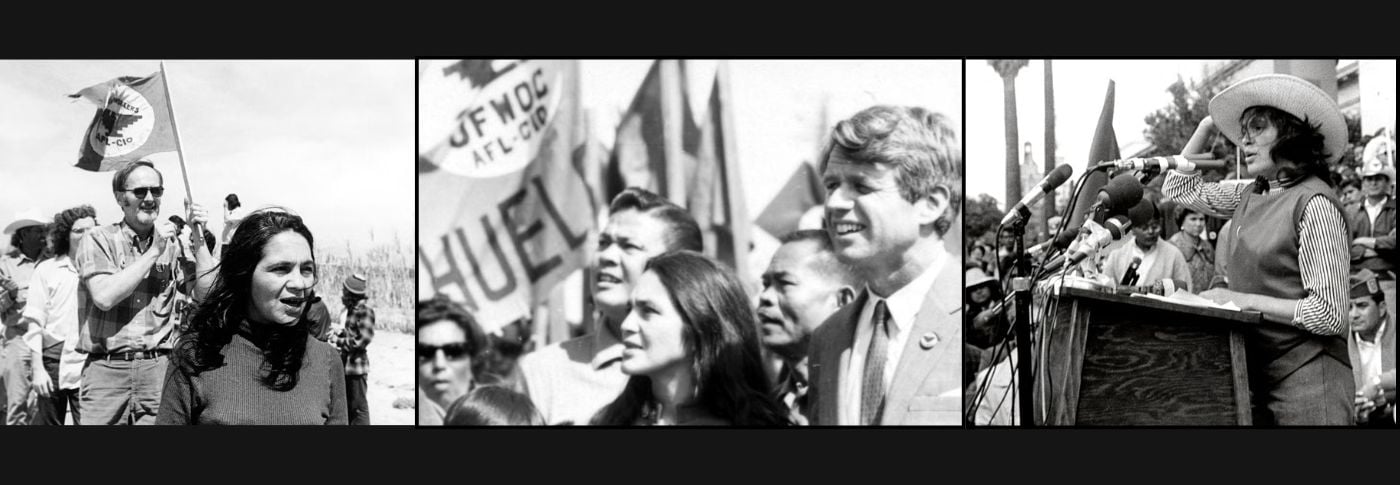
lack-and-white composite of three archival photos of Dolores Huerta: speaking on the UFW picket line circa 1970, marching with farmworkers in Sacramento after the 1966 Delano march, and addressing a crowd at a podium at a rally in Delano alongside Larry Itliong and Senator Robert Kennedy.

Left to right: Dolores Huerta on the United Farm Workers picket line, c. 1970 (Walter P. Reuther Library, Wayne State University); Huerta speaks to farmworkers in Sacramento after the 300-mile march from Delano, April 10, 1966, photo by John Kouns (Farmworker Movement Documentation Project); Andy Imutan, Dolores Huerta, Larry Itliong, and Senator Robert Kennedy at a rally in Delano before Cesar Chavez broke his 25-day fast. All images courtesy of The Phillip & Sala Burton Center for Human Rights.

March 19, 2026

The Movement Is the Hero: Farmworkers' Rights, Survivors, and What Comes Next After the César Chávez Investigation

A New York Times investigation into Cesar Chavez has shaken communities across the country. But the farmworkers' rights movement was always bigger than one man. This lesson centers the survivors, the movimiento, and the people who actually built the UFW.

Share

Share On Facebook
Share On Twitter
Share On Pinterest
Share On LinkedIn
Email

Note to Educators: Please Read Before Teaching

This is a lesson designed to support you, not just warn you. The César Chávez investigation is exactly the kind of story educators shouldn't have to navigate alone, and this resource is built to help you bring it into the classroom with care. It names the harm clearly but does not include graphic details. 

Before using this lesson, consider the following: 

  • Know your students. Any classroom may include survivors of sexual abuse or family trauma. This topic can activate real responses.
  • Establish norms before discussion. "This is a space where we take difficult truths seriously and treat each other with care."
  • Have resources ready. Know your school counselor's contact. RAINN's National Sexual Assault Hotline: 1-800-656-HOPE (4673) or rainn.org.
  • You don't have to have all the answers. Some of the most honest things an educator can say are 'I don't know' and 'let's figure this out together'.
  • You know your community. Some contexts, such as recent local trauma or particular student histories, may call for pausing or significantly adapting this lesson. 

This lesson focuses on the farmworkers' movement, the survivors, and the harder questions of how we hold complexity in history. It is designed to be taught, not avoided. 

The Movement Was Never One Man

Gustavo Arellano grew up in Orange County, Calif. His mother was a farmworker, picking crops as a child in Central California. When he was young, he had never heard of Cesar Chavez. When he finally did learn about him, he admired him: someone fighting for one of the most exploited groups in the American economy, as he put it, "since the beginning of this republic." 

This week, Arellano, now a Los Angeles Times columnist, published a piece called "The Cesar Chavez Myth Is Punctured." He didn't write it to tear down a movement. He wrote it because the movement deserves the truth. 

On March 18, 2026, the New York Times published a major investigative report alleging that Chávez, co-founder of the United Farm Workers union and one of the most celebrated Latino civil rights leaders in American history, sexually abused girls who grew up inside the farmworkers' movement. Multiple survivors have come forward, including Dolores Huerta, Chávez's most prominent co-leader. The United Farm Workers has canceled its annual Chávez birthday celebrations. Governments and school districts across the country are reviewing streets, schools and holidays named in his honor. 

But here's what Arellano said in an NBC interview this week that every educator needs to hear: "It was a movimiento. A movement. It wasn't adulation of one man. That was a mistake that his followers made in the years and decades that followed." 

This lesson is about who actually built the farmworkers' movement, what they won, and why the truth about Chávez makes that story more important to tell, not less. 

Remote video URL

Huelga: The Fight That Changed Everything

In the early 1960s, farmworkers in the U.S. had almost no legal protections: poverty wages, dangerous conditions, no right to organize. Most were Latino. Many were immigrants. In 1962, César Chávez, Dolores Huerta, Larry Itliong and Gilbert Padilla co-founded the United Farm Workers union. Itliong, a Filipino American labor organizer, launched the California grape strike in 1965 that became the movement's defining campaign. Through strikes, boycotts and massive marches, they forced the country to reckon with the people picking its food. In 1975, California passed the Agricultural Labor Relations Act, the first U.S. law guaranteeing farmworkers the right to organize. It was a historic victory built by thousands of ordinary people. 

On March 18, 2026, the New York Times published findings, based on more than 60 interviews and hundreds of pages of documents, that Chávez sexually abused girls inside the movement. Two survivors, Ana Murguia and Debra Rojas, both now 66, say the abuse began when they were 12 and 13. Dolores Huerta, now 95, disclosed publicly for the first time that Chávez had assaulted her, a secret she carried for nearly 60 years. Many women said they stayed silent out of loyalty to the movement, and because others around Chávez actively discouraged them from speaking. 

The UFW canceled its annual Chávez Day celebrations. Governments across the country began reviewing streets, schools and parks named in his honor. 

The rights the farmworkers won are real and they still matter, especially as farmworkers face new threats to labor protections and immigration status today. As survivor Esmeralda Lopez said: "The movement—that's the hero." Focusing on survivors isn't about erasing what the movement built. It's about telling the whole truth of who it actually belonged to. 

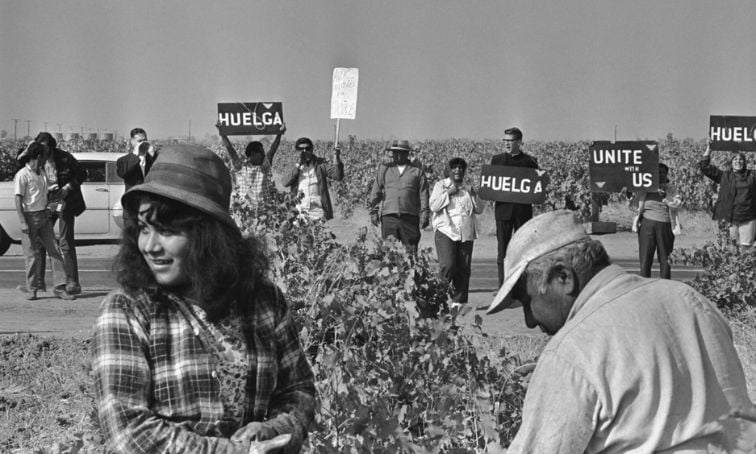
Black-and-white archival photo of the 1965 Delano grape strike. Two farmworkers work in a vineyard in the foreground while a line of strikers stands along the road behind them holding signs reading "Huelga" (Spanish for strike) and "Unite With Us."
Farmworkers strike in the vineyards of Delano, California, 1965. The signs read "Huelga" — Spanish for strike. The Delano grape strike, launched by Larry Itliong and the Agricultural Workers Organizing Committee, became the defining campaign of the farmworkers' rights movement. United Farm Workers. Public domain.

Key Terms/Cheat Sheet

  • Movimiento: Spanish for "movement." The word farmworker organizers used to describe their collective struggle, with power rooted in people, not any single leader.
  • Huelga: Spanish for "strike." The rallying word of the farmworkers' movement, carried on signs during the 1965 Delano grape strike and chanted on picket lines across California.
  • Collective bargaining: When workers negotiate together with an employer for better wages and conditions. Without it, workers negotiate alone, and employers hold most of the power.
  • Agricultural Labor Relations Act (1975): The landmark California law that gave farmworkers the right to organize for the first time in U.S. history, won through years of UFW strikes and boycotts.
  • Survivor: A person who has experienced abuse or assault. Many advocates prefer "survivor" over "victim" because it emphasizes resilience and agency.
  • Institutional silence: When an organization knows about harmful behavior by someone in power but fails to act, often to protect its own reputation. This can happen inside any institution, including unions built on justice. 

Discussion Questions

Survivors and silence: Ana Murguia, Debra Rojas and Dolores Huerta stayed silent for decades, some pressured by people who feared the truth would hurt the movement. What does it take for someone to come forward when the person who harmed them is considered a hero? Who gets believed, and why? 

Power inside the movement: The farmworkers' movement was built on dignity and justice for the powerless. How was abuse possible inside that institution? What does this tell us about how power works, even in organizations fighting for equality? 

The movimiento belongs to the people: Gustavo Arellano says elevating Chávez to a singular hero was a mistake made after the fact, that it was always a movimiento, not one man's story. Who else built the UFW? What do we lose when we tell history through one person's name? 

Naming and reckoning: Cities are debating whether to rename streets, schools and parks. Arellano says some will add context, others will rename; both responses show community strength. What factors should guide that decision? Is there a difference between erasing history and correcting it? 

Still fighting: The rights won by the UFW in the 1960s and ’70s are not fully secured. Farmworkers still face poverty wages, unsafe conditions and immigration threats today. How does knowing that change how you think about what the movement still means?

Media Literacy + Critical Thinking Challenge 

How is this story being told—and by whom?

Who's in the room? The NBC clip features Gustavo Arellano, a Latino columnist whose mother was a farmworker. How does his background shape what he says and how he says it? How might this interview feel different with a different commentator? Why does it matter who gets to analyze stories like this publicly? 

Compare the coverage. Find two outlets that covered this story, a mainstream national outlet and a Latino-focused one (such as La Opinion or Prism). What does each emphasize? Are survivors centered or backgrounded? Is the UFW's labor history included? What explains the differences? 

What's verifiable and what isn't? The Times cites 60+ interviews, union records, audio recordings, archived letters and DNA results. Which types of evidence seem most compelling to you, and why? What would you want to know about how reporters obtained and verified this material before you trusted it fully? 

Who's missing from the story? César Chávez died in 1993 and cannot respond. Some who knew him dispute the allegations, and some women connected to the movement say they experienced nothing like what the survivors describe. How do you weigh competing accounts? What questions would you ask if you were one of the reporters?

Extension Activity: Labor Voices 

Option 1: Heroes, Sheroes and Local History. Gustavo Arellano tells his college students: "I'm going to teach you about heroes and sheroes that have never made it into the textbooks and probably never will—but those types of people exist in your communities." 

  • Research a labor organizer, farmworker advocate or community activist from your own city, county or state who has never made it into a textbook. Write a one- or two-page profile: Who were they? What did they fight for? What did they win? Share your findings as part of a class "local labor history" wall. 

Option 2: Letter to the Movement. Write a letter addressed not to Chavez, but to the farmworkers' movement itself—to the organizers, the strikers, the mothers, the workers still in the fields today. What does the movement still stand for? What do you think it owes the survivors?

Keep Teaching the Movement

Explore free classroom resources on farmworkers' rights, labor organizing, and Dolores Huerta's legacy in our Dolores Huerta & Farmworkers' Rights Lesson Plans collection.

Andy Kratochvil
Andy Kratochvil is a proud member of the AFT Share My Lesson team, where he’s passionate about discovering and sharing top-tier content with educators across the country. He earned his bachelor’s degree in political science and French from California State University, Fullerton, and later completed... See More
Advertisement

Post a comment

Log in or sign up to post a comment.